
Reflections
- Shannon Cox
- Jan 7, 2019
- 19 min read

Updated: Mar 16, 2019
Reflection 1 for January 14th: Social Media and Persona

For this week's exercise, we had to pair up with one random stranger and swap social media profiles. Without discussing details about each other one one one, our goal was to stalk the social media site of our partner and get a better understanding of who they are, or at least who they portray themselves to be online.

After stalking the Instagram of my partner, Robyn, she seemed to have a pretty similar social media page to what I had imagined she would have at first glance. Robyn's Instagram focused mainly on her love for music, art, and her close friend's and family. When looking at Robyn, I thought she had a love for music because she was wearing a vintage Led Zeppelin shirt and also was carrying a notebook with the popular music magazine, Rolling Stones, iconic tongue and lips logo on the cover. In continuation, Robyn also seemed to be on the more artsy side because she wrote poems and doodled pictures in her notebook, one of which is now a tattoo on her arm. She also seemed to have many friend's in the class, some of which are featured in her Instagram posts.
Furthermore, I did not feel Robyn had a different persona on social than her true self. That was until I read aloud to the class what her social media page was like. When I touched base on the fact that Robyn writes poems and publishes them to her Instagram page, I could see her squealing nervously and falling into her seat as if to shield herself from people's reactions. I was surprised by her reaction because she is open to publishing these poems on social media, but when discussed in person she is too shy to talk about it.
Instances like these, show the true effect social media has on people. Most people feel that these platforms give them a voice that they wouldn't be able to have in the real world. However, is this a perk or downside to social media? If you are unable to say or do something in the real world, is posting something online truly a reflection of yourself or the person you want everyone to believe you are.

Take my Instagram for example. I take so much time editing my pictures and making sure they have the perfect filter, when in reality the picture is not an accurate depiction. The burning orange sunset that you see me post on Instagram, most likely was a pale peach at the time I took the picture. However, after hours of editing, it has become the masterpiece it is.
People are not the only ones guilty of creating a perfect persona for the public to see. Companies like McDonalds or Burger King, will post images of their food in Ads that look nothing like the crappy burger you get in person. However through altering the photo, they can make a dollar menu burger look like a gourmet meal. Like these brands, we are altering who we are online because we want people to see the best version of ourselves.
What I have learned, is that no matter who you claim to be, the true version of you will always come out. Therefore, maybe it's time to highlight who we really are because people might appreciate seeing the real you more than the persona you have created online.
Reflection 2 for January 21st: Can a Persona be taken "Too Far"
This week we spent a portion of class watching a video that has become an internet sensation.
Oohbah Butler, reporter for vice, chose to video himself as he fooled London foodies into believing that his outdoor shed was London's number one restaurant. Oohbah, who is well known for his segment "Life Hacks with Oobah Butler," took on this project because he noticed how much people value restaurant reviews online. He wanted to see if by generating these fake reviews and posting elevated pictures of food he has made and of the restaurant that is only the outdoor shed he lived in, if he could gain the trust of those who look to trip advisor for reviews and ultimately become rated number one.

The fictitious restaurant, named The Shed at Dulwich, became London's number one rated restaurant on trip adivsor in under 6 months. Just from generating fake reviews and pictures, the restaurant was London's hotspot to the eyes of the trip advisor users. Soon, the phone Oohbah used as the contact of the restaurant on trip advisor, was booming with calls for people who were hoping to get a table. Ultimately, for one night Oohbah did open the restaurant. However, his entire lie leaves me wondering if the restaurant persona he created, is truly ethical
During the time that Oobahs restaurant was gaining popularity, many people were taking time out of their day to try and apply to his restaurant for jobs. These people did not even have a clue that they were wasting time on trying to call or apply to work at a restaurant, that does not even exist. Oobah himself even said that people were sending the address he labeled as The Shed at Dulwich care packages to try and convince the restaurant to allow them a seat one night. People took tim e out of their day to do all of this, and he just laughed as it was happening.

For this reason, I believe personas can sometimes be a dangerous area. You are meant to show people a different side to you or of the image you have created. However, is it right to act like the rest of you does not exist or even in this case, that their is not another side to this "amazing restaurant" that people believe is only a restaurant. After reading up on personas, most of the time people you are showing this persona too are aware that their are other sides to you. Therefore, in this instance, persona might be too loose of a word.
Oobah, in my opinion, just created one big lie.
Reflection 3 for January 28th: Is Boasting OK?

This week, we spent the majority of our class getting to know one another, on both a personal and professional level.
Our instructor asked us to take a couple minutes and write down qualities and skills we each have that would make us an effective group member. I was comfortable writing down all my attributes on paper, but discussing them out loud make me feel a bit nervous.
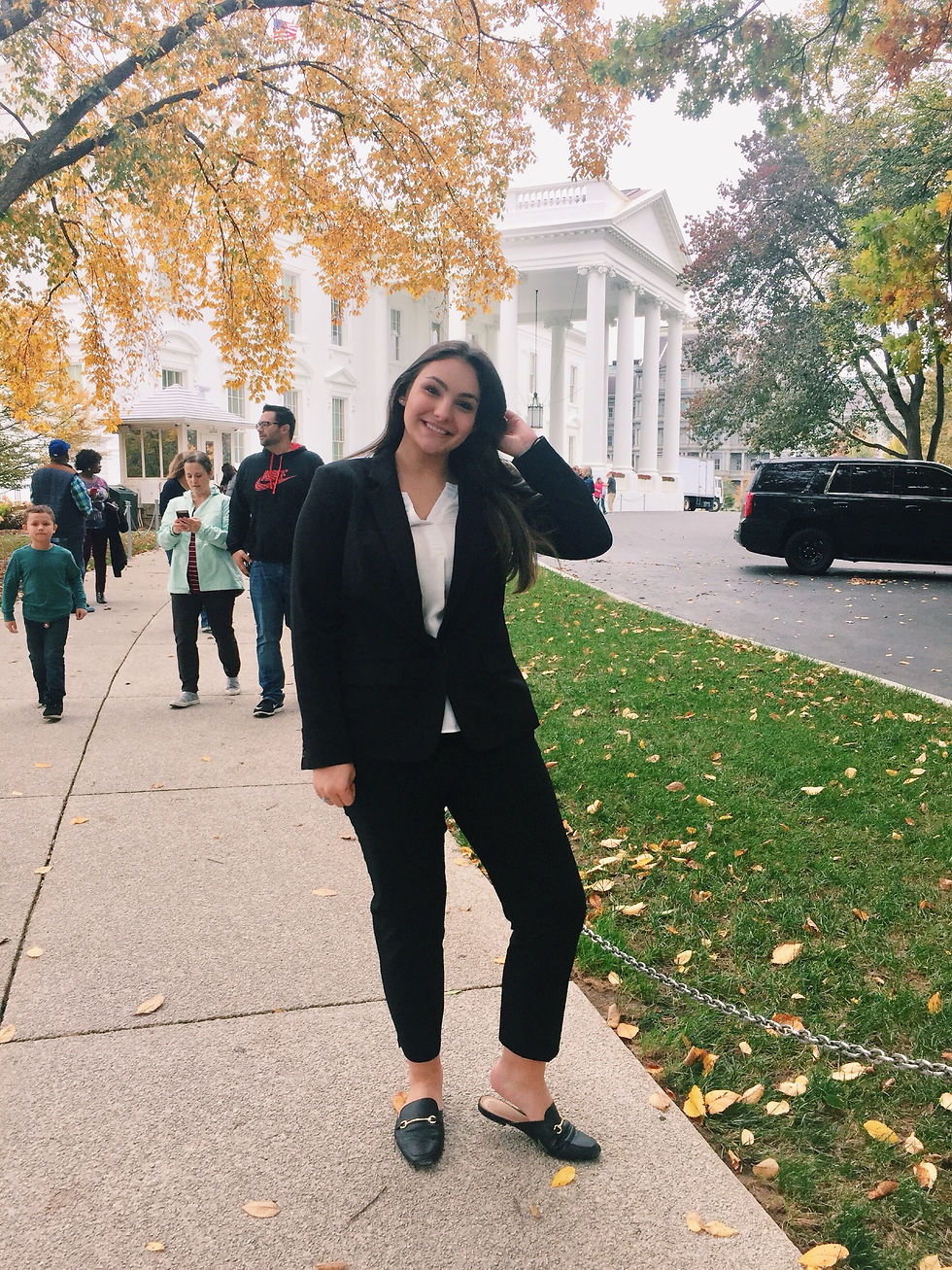
Now, it is important to know that I am a confident public speaker, so that is not at all why I was nervous to speak. But, when it comes to boasting about qualities I obtain, I fear that sometimes I could come off rude or self-centered. I am extremely proud of what I have achieved thus far in my life, having just last year been invited to Washington D.C.(pictured) for a Pre-Law Conference with the nation's young and hungry pre-law students. But,that is something I feel comfortable putting on a resume more than talking about in person.
However, as we started going around the table, I realized the value of discussing your own attributes with others. Not only was I able to get across details about myself, but I was able to make connections with others about skills we share and even those we don't, that ultimately could benefit one another from learning.

I even felt that because I am an abroad student, I had even more to offer to a group dynamic. It felt good being wanted, and also valuing the skills and attributes others have to offer. I think this is a great ice breaker and should be used more in a college setting because it not only contributes to class discussion, but it also is a great networking opportunity for peers and instructors to find out more about one another.
Therefore, Boasting can be Ok, as long as you are valuing the skills others bring to the table that could make your solo performance, a group masterpiece!
Reflection 4 for February 4th, 2019: Social Media and its Effect on Campaigns

This week, we got into our groups to discuss the persona/mascot each group will take on for the semester and what each one will be promoting.
My group, GAME OF PHONES, agreed on using teddy bears to promote mental health awareness and positivity through posting online pictures daily/weekly of the bears experiences along with it's interactions with university students. Our hope is to spread love and kindness through the bear, and for the bear to be a symbol of mental health initiatives. (look to Developmental Work for more info on that assignment)

As my group and I were planning our campaign, I started to realize how much of an impact social media had on not only our campaign, but campaigns of all kinds. For example, the Me Too Movement began as a #hashtag on social media platforms to help survivors of sexual harassment and assault have an outlet to tell their stories. It grew into such a widespread phenomenon, as survivors from all over had a place on social media to discuss this issue. The social media community can reach such far distances, far beyond flyers and spoken words can, that nearly everyone online can become a part of a single campaign. It also connects people offline by building a community surrounfing the campaign, that is willing to have meet ups and in person discussions on the issue

Don't get me wrong, social media can have negative impacts too, especially in regards to cyber bullying. Many find it easier to post harsh things online, rather saying something to someone face to face. However, I feel the best way to combat negativity on social media is by using these platforms to promote positivity. I am a firm believer that love always combats hate & always wins. Therefore, in the future I hope to promote the positive aspects of social media and try to show older generations who only find the negative sides to it, have a better understanding that social media was created for the communication of ideas from person to person. It has the power to spark positive change on the world and it is a huge benefit for all.
Reflection 5 for February 11th, 2019: Importance of Pitching

At the start of class this week, all of the online storytelling groups gathered around a large conference table. Each group had about 2-3 minutes to pitch their social media personas and mascots to the class.
When we were first asked to do this, I could not help but think how unprepared I felt to do such a pitch. My group members and I had just finished figuring out what our social media persona was going to be, and we barely had time to sit and think to ourselves of how we hoped to map out our entire project. However, all of the other groups were on the same boat as us, and that is what made pitching our story's actually a wonderful idea. Since all of our projects were in its beginning stages, we were able to share idea amongst all of the groups that would help them to develop their project and set them on the straight path from the start.

For example my group, GAME OF PHONES, are choosing to use the Instagram & Twitter handle @littlebearthoughts. The sites will feature two small teddies, Bettie and Bertie, and their journey of sharing positivity and advice to their followers of how to cope with mental health, including day to day ways to relieve stress. As we were pitching our idea, other groups said that when we are speaking directly with our audience that are dealing with mental health issues of their own, it is important to always let them know we are not trained professionals and make them aware of the resources that are available to them if needed. While we do hope to spread positivity, we must also remain cautious that some people need more than just happy daily quotes featuring a teddy, and that it is important to make people aware of their resources from the start.

I also think that pitching is an amazing way to network with other people who share common likes and dislikes. One of the other groups are running and environmental campaign, featuring cartoon waste products. I think this is an awesome way to get people talking about environmental issues and what we can do to save our planet. I decided to follow their page just after hearing their pitch and connecting with their ideas. Unless they had pitched their idea to me, I would have never known of this campaign and it would have remained out of my sight. Therefore, when it comes to work and business, I will look to the future for pitching ideas as I find that receiving constructed criticism is the best way to take your project from good to great!
Reflection 6 for February 18th, 2019: Engaging Audiences

This week I thought it would be the perfect opportunity to write a blog post about the importance of engaging audiences when you are looking to brand yourself and your campaign on social media. I have come face to face with this during my own struggle to brand a mascot my friends and I have created for our course, mostly because of the difficulties one faces at the start of a campaign. How do you manage to get an initial interest from people starting from scratch?

We can all admit that on social media nowadays, its all about how many followers you have and how many likes you get. If I see someone who has a lot of followers and gets a ton of likes on their posts, I automatically assume that they are well liked and that people must be enjoying the content they are publishing. It also drives me to like their content more and follow them because everyone else is. Therefore, the odds are not in our favor when you are trying to engage with audiences who don't see the value of your page.
So the big question is how to engage audiences when you don't have followers to support you in the beginning?
I have learned that it is important to gain attention by posting and publishing content that people are interested in. In order to gain your audience, you have to familiarize yourselves with them. A new popular feature to use on Instagram is polls. People love giving input, so if you ask people what kind of content you should publish, they will answer. Also, tagging locations and using hashtags is also an advantage because people often search and follow people based on their location and the hashtags they use (Ex. #positivity #bearthoughts) Also follow accounts that have similar content to what you will be posting, for inspiration. You can also follow those accounts followers because 9 times out of 10 they will follow you back if you post similar content.

As much as I hate saying it, also ask your friends and family to repost content from your page or shout-you-out on social media. The more people you get to engage with your campaign, the faster and the more it will grow. Just a simple post like, "Follow @lilbearthoughts for inspirational content and to see the journey's of the two lil bears, Bertie and Bettie." That is getting your mission out there while also not being too in your face to the public. Lastly, constantly be active on social media. You can not go days without posting content and expect people to not unfollow you. Make sure to always have an active presence and even if you do not post photos, try to reply to others and make sure that the public is aware you are very much active and still around.
Reflection 7 for February 25th: Using your Platform Carefully

Through our entire social media campaign for online storytelling, I always believed that the importance of follower count was the highest regard and what we needed to focus on the most, Even last week, I wrote my last reflection on the importance off followers and how one can engage their audiences to gain more attention and followers on social media. However, as our project has continued, I realized that though follower count is important, you have to make sure that the people you are following are genuinely interested in your mission in the first place.

For example, one of my jobs in my group project is to help run the Twitter account and to post, follow, like, and respond to tweets. I was looking for more interaction from the Twitter audience, so I decided to follow pages with similar mental heath initiatives as our own, and in doing so I also followed many of the followers that these pages had. I will be honest and say I did not look at the accounts and see who the followers were and what they usually posted about. I had more so just assumed that since they were following accounts similar to mine, the content they were retweeting and publishing themselves would match our own.
While some of this is true, and we were able to gain followers with similar ideas as our own, we also had a couple "rotten egg" Instagram followers. While following the random accounts, I did not notice that many of the posts from these followers were deemed as "sexual" and "erotic' content. Clearly, these were not the kind of followers we were were looking for, but as I was on my following spree, I did not even pay attention to who I was following. I was more concerned about getting followers, that I did not care about the quality of these followers. Account like the ones we stumbled upon are also looking for a massive amount of likes and follows so similarly, they will follow random pages with the same "follow for a follow" mentality.

Through this mistake, I have learned that a part of you must remain true to yourself and your mission hen looking for pages to follow on your platform. You want to have people on your page because they want to be, not because they hope through following you, you will follow them back in return. If you want to develop your page and brand yourself and your mission, you must surround yourself with others in the social media community that also want your page to succeed for the same reasons. Therefore, be more cautious of who you follow and who you will allow to follow your social media. Its not a matter of being picky, but it is mostly a matter of ensuring you are using your platform for the right reasons and accomplishing the mission you set out when you started. I have realized that the quality of your followers and their interest in your content, is far more important than quantity of followers that may not even give your page the recognition and appreciation it deserves.
Reflection 8 for March 4th: Social Media and Mental Health
I recently stumbled upon a Ted Talk at Ryerson University discussing the effects of social media on mental health. This Ted Talk caught my eye because I currently am using an online social media platform to create a persona, for a positive mental health initiative (@Lilbearthoughts). The discussion, conducted by Bailey Parnell, gave an in depth look at Parnell's research into how social media can negatively affect mental health.

Parnell began discussing her realization of this concept when on a holiday with her sister in Canada. Parnell vowed to herself to stay offline for the entirety of her four day vacation, but found it to be a huge struggle and was deeply upset by how much being on social media mattered to her; not only personally but professionally. She felt an attachment to her phone and to these sites that whenever she was not on them, she felt "naked" and stripped. It is then when she began to realize the negative affects of social media on the mind that she had never caught before. Falling within the age range of 18-24 meant that Parnell, and others like myself, are the most active on social media. We constantly are scrolling to see who liked our posts, who is on vacation, even who just go married While scrolling we are thinking "Why didn't they like my post"....."I wish I was on vacation"....."Why was I not invited to the wedding." We always are comparing ourselves to our peers and we are addicted to doing just this.
Parnell went on to say that the most common diagnoses on college campuses are:
1. Anxiety
2. Depression
3. Stress
More so, numerous studies from the U.S., U.K., and Canada have linked these issues to social media use and obsession. It is so easy to constantly be on social media nowadays because everyone is; you almost have to be in order to stay in touch with the outside world. Rarely does anyone call each other or mail post cards and letters updating family and friends on their lives. In order to do update, you will post a photo or two with a caption and location on social media, so that others can engage with you and see what you are up to. I can be honest and say that I scroll through social media for hours and get upset at the amazing lifestyles and perfect bodies of friends that I see. I get so jealous, wishing I could be where they are and look like they do. Wishing you were someone you are not is a sign that maybe social media is turning us and changing us to be someone we are not. Even scarier, if we don't let it change us, we fall into a ring of depression because we have the, "I'm not good enough," mindset.

This subject is tough for me because although I myself have experienced the stress and anxiety of social media, I still do believe social media has its upsides. Specifically, through accounts like mine (@lilbearthoughts), I believe we re setting the record straight that positive mental health can exist on social media. The purpose of our account is to shed light on mental health and keep positive mindsets. The ironic thing is that we are using social media to promote these ideas. I believe I am even more happy now, than before, that we are using an online platform to inspire positive mental health. Because of the statistics I heard in the Ted Talk and from Parnell about the link between depression and bad mental health, I believe my page is looking to fill the gap that social media is lacking. Through posting on social media, followers who might be in the same mental state as Parnell and I were, can also see our posts and realize they are perfect the way they are and that they don't need t change who they are for anyone. Therefore, it is up to us to remain aware of the issues surrounding social media, but starting campaigns under hashtags like #positivementalhealth & #mentalhealthawareness, so that we can end the statistics and links between social media and negative mental health.
Reflection 9 for March 11th: Three Infamous Online Personas

Pictured Above: Popular online character, Miranda Sings
While my group members and I are developing are own social media persona through Bertie and Bettie bear @lilbearthoughts, we reflected on popular social media personas for inspiration on gaining success in our own. Below are three of the most influential online personas of all time:
1. Miranda Sings

Miranda Sings is a fictional character created on the Internet in 2008 and portrayed by American comedian, actress and YouTube personality Colleen Ballinger. Ballinger displays videos of the comically talentless, egotistical, misguided and quirky character on her YouTube channel. In these videos, the eccentric, narcissistic, yet endearing character sings and dances badly, gives inept "tutorials", recounts her daily activities, discusses current events that she often misunderstands, collaborates with other YouTubers, and rants about her critics, reading examples of hate mail directed at the character on social media; she responds to them with her catchphrase: "Haters Back Off!". Many love her because of her larger than life personality and comical faces. Colleen, herself is also a well known YouTuber and singer who flips between posting on her normal account and as Miranda on Miranda's account. As we have learned, Miranda is a persona of Colleen, which basically means she is a sort of side personality or portion of her that is exaggerated and glorified for the purposes of gaining attention. Similarly, our bears do not talk or speak themselves, but they are a part of us who exaggerate them for the purposed of gaining attention for our mental health initiative .
2. Joanne the Scammer

As his drama-loving alter ego Joanne the Scammer, Brandon Miller has amassed a following of nearly 3 million people across Twitter and Instagram. But that understates his impact, both in popularizing the concept of “scamming” (trying to take any advantage you can get in a bum economy) and in building a bona-fide brand that now comprises an emoji app, a documentary, a TV series and alliances with celebrities such as Nick Jonas and Ariana Grande. Along the way, Miller has caused a fair. But in the words of Joanne herself, “A day without a scam is a day wasted.” This persona is largely different then Miranda Sings, as Brandon is a straight male and his persona is a straight, provocative female. Brandon does not feel the stress to ensure everyone knows he is straight because he clarifies how his persona is a part of him, but not who he actually is. This shows how we can be opposites to our persona.
3. Fred Figglehorn

Fred Figglehorn is a fictional character created and portrayed by American actor Lucas Cruicshank. Fred is a six-year-old boy with a high-pitched voice, dysfunctional home life, and "anger management issues. Cruikshank, a teenager from Columbas, Nebraska created the Fred video series for his channel on YouTube, to center on the Fred character. Although Cruikshank voices Fred, the audio is digitally altered to sound higher-pitched than Cruikshank's true voice. Cruikshank has not portrayed his Fred character since 2010 however, to this day, his videos and movies still receive a mass following and he is recognized as one of the first internet persona's of his kind. As stated, just through creating Fred, Cruicskank has gotten movie deals and product selling deals for channels like Nickelodeon and Cartoon Network. His success shows that personas can gain a mass audience from constant activity and engagement.
Reflection 10 (FINAL REFLECTION) for February 18th: What I Have Learned

Over the course of the past 10 weeks, I have written reflections based on the thoughts, feelings, and emotions I have has while developing my group project and engaging in class activity. In the beginning I thought it would be difficult for myself to write about topics each week, as I didn't feel I would be gaining much insight in creating my group project alone. However, through Online Storytelling and writing these posts each week, I have learned so much information about online personas, social media, and enhancing one's self.

The first week I talked about the beginnings of social media and persona. Our class had to pair off with a stranger and stalk each others social media profile. In doing so, I realized how my partner was different than the social media profile she had. In real life, Robyn is very shy and quiet, but on social media she posts often and is not afraid to show more sides to herself. This is where I began to understand that people can be much different than their online profile, without being fake. The person that Robyn is on social media, IS one side to her. It is a persona of her that is more open and able to communicate her thoughts better. The second week I discussed how one man, Oohbah Butler, created a fake restaurant and was able to make it become the Number #1 rated London restaurant on Trip Advisor. I was upset by this because I believed in this instance, the persona he was building up, was taken way too far. For a fake restaurant, people were taking time out of their days to apply to it for a job and try and get a reservation, and he completely wasted their time. The third week we talked about Boasting and how at first I believed it was a self centered concept. However, depending on the setting you are in and if you are detailing your strengths in a group setting, I believe it is a positive experience that can help you and your group members find your skills.

The fourth week I discussed how much effect social media has on campaigns like #MeToo and #BlackLivesMatter, and other online based movements in our time. The platforms in themselves have become online communities where people can unite and take action. The fifth week, my group and I presented our project work up to this date, and it showed to me the importance of pitching and presenting your ideas to a group of people. Their feedback helps to improve your project and get a good sense of what you still have left to develop. Week six, I focused on importance of engaging audiences on social media while week seven, I talked about how you must be careful during engagement to ensure your audiences are who you want them to be. Week eight, I focused on how we must combat the idea that social media can negatively affect our mental healths, and that it is up to us to make the social media experience positive. Lastly, week nine I focused on the roots: Internet Personas. Specifically, those who have inspired my group members and I into developing our personas for our group project.
As you can see, the past couple of weeks have taught me so much. I have seen the positive and negative affects of the digital age, especially in regards to social media and the online community, while also being inspired by ideas in the classroom to help students engage with one another, show of their skills, and help each other to improve their work. I am extremely thankful to this class for teaching me far beyond what a classroom lecture could have, and I look forward to the future for continuing to write reflection blogs during different moments of my life, highlighting and keeping close the important lessons I have learned.


Comments